

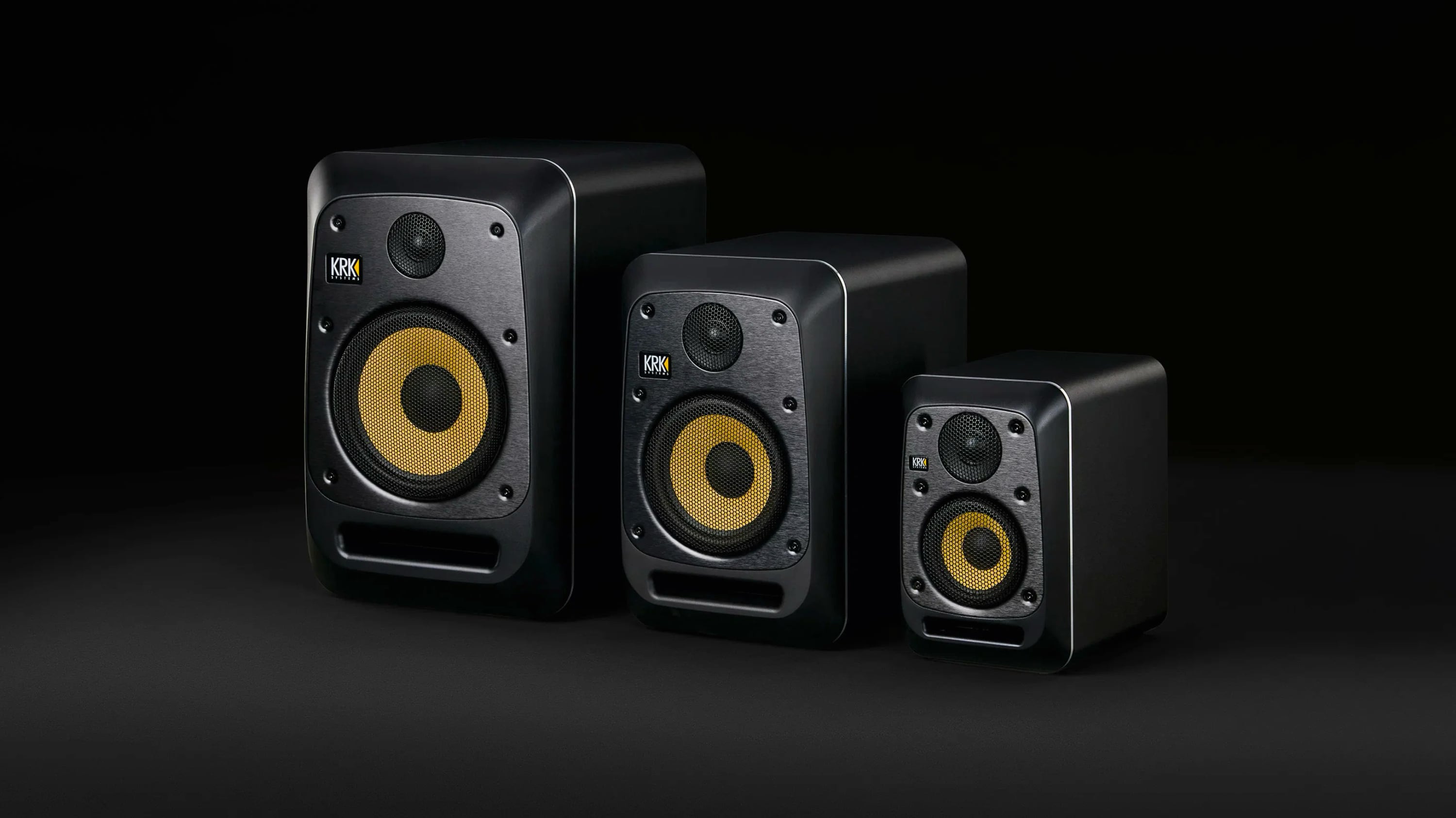
Watch enough studio footage and sooner or later two yellow circles will appear in the background. Sometimes they sit in a large commercial control room. Sometimes they are on a modest desk beside a laptop. KRK monitors are instantly recognisable, even to people who could not explain the difference between a studio monitor and a conventional hi-fi speaker.
The bold design helped KRK stand out, but colour alone does not sustain a brand for almost four decades. KRK monitors found their way into professional recording studios and thousands of smaller production rooms. ROKIT became one of the best-known studio monitor ranges in the world, while the yellow woofer developed into a visual shorthand for music production itself.
You can now find KRK studio monitors at Stage IQ. Before choosing a pair, however, it is worth looking beyond old assumptions. The current ROKIT G5, KREATE and V Series ranges serve different kinds of studios. The difference between a 5, 7 and 8 inch monitor also matters, and the room can influence what you hear just as much as the monitor itself.

A studio monitor should not flatter the music
A home audio speaker is usually designed to make music enjoyable. A manufacturer may add a little weight to the bass, soften a harsh recording or create a greater sense of space. There is nothing wrong with that. It is simply what the speaker is designed to do.
A studio monitor has a different job. It needs to reveal what is actually happening in the recording. Is the vocal too loud? Are the bass guitar and kick drum competing for the same space? Does the reverb linger too long? Is there enough room for each instrument in the stereo image? The less a monitor hides, the fewer unpleasant surprises remain when the track is played in a car, through headphones or on a phone.
This is why a good studio monitor may not be the most impressive speaker in the first minute of listening. Its value becomes clear after several hours of work, when decisions come more quickly and mixes require fewer corrections on other playback systems.
KRK began with a practical problem
KRK was founded in 1986 by Keith Rowland Klawitter, a film sound engineer who felt that the monitors available at the time did not let him work with the precision he needed. Instead of accepting the limitation, he began building his own speakers in a garage in Huntington Beach, California. His initials appeared on the first designs: K. R. K.
The early monitors were built in small numbers for fellow engineers. The active Exposé range, introduced in 1996, helped establish KRK in professional studios. In 2005, the first active ROKIT range arrived at exactly the right moment for the fast-growing home studio market.
More music was being made on computers, but a professional monitoring setup still often meant a separate amplifier, expensive passive speakers and a fair amount of technical knowledge. ROKIT offered a more direct route. The amplifiers were built into the cabinets, connection to an audio interface was straightforward, and the price made serious monitoring accessible beyond large commercial studios.
How did the yellow cone become a studio icon?
The yellow woofer gradually became KRK's signature. It remains visible in a dim control room and is immediately recognisable in photographs and videos, but the colour is only part of the story. Current ROKIT G5 monitors use a woven Kevlar® aramid fibre cone. A light, rigid diaphragm is easier to control, helping reduce unwanted resonances and improve definition.
That strong visual identity had an interesting side effect. As more ROKIT monitors appeared in producer studios, live streams and artist interviews, the sound of one particular generation was often attributed to the brand as a whole. Even now, KRK is sometimes described as a bass-heavy choice intended only for electronic music.
Earlier ROKIT generations did have a more pronounced character that appealed to many hip-hop and electronic music producers. The fifth generation is a far more flexible design. One monitor can now support several stages of the creative process, and its response can be adjusted to suit its position in the room.
ROKIT G5 listening modes are more than a brochure feature
Current KRK ROKIT G5 monitors offer three listening modes. Their value makes more sense in a real session than it does in a specification table.
- Mix provides a flatter frequency and phase response. This is the main setting for mixing, mastering and judging the overall balance of a track.
- Focus brings the midrange forward. This is where much of the information in vocals, guitars, keyboards and acoustic instruments sits. The mode makes it easier to hear when several parts are masking one another.
- Create is intended for writing, arranging and producing, when maintaining creative momentum matters as much as analysing every detail.
A practical workflow might look like this: write and arrange in Create mode, shape the main balance in Mix mode, then use Focus mode to inspect the relationship between vocals and instruments. This does not replace a second pair of monitors or checks on other playback systems, but it does provide another useful perspective at the press of a button.
The rear DSP offers 25 combinations of boundary and equalisation settings. They are useful when monitors need to sit near a wall, on a desk or in another less than ideal position. Expectations should remain realistic, though. Electronic correction can reduce an excess in a specific frequency range, but it cannot remove flutter echo from bare walls or repair a poor listening position.

ROKIT Generation Five: official overview
This official KRK video demonstrates the ROKIT G5 listening modes, DSP controls and the main design choices behind the fifth generation.
What is the difference between 5, 7 and 8 inch monitors?
The number in the model name refers to the approximate diameter of the woofer in inches. A larger cone will generally reach lower frequencies and produce a higher sound pressure level. It will also excite the room more strongly at low frequencies. For that reason, an 8 inch monitor in a small room is not automatically an upgrade over a 5 inch model.
Before choosing, consider three things: how far you will sit from the monitors, how much space you have behind and around them, and whether the room provides even basic control of reflections and low frequencies.
KRK ROKIT 5 G5: for compact workspaces and close listening
The 5 inch model makes sense when the monitors sit on a desk, the listening distance is short and the room is not large. Its frequency response extends from 54 Hz to 30 kHz at ±3 dB, covering most of the information needed to judge a mix while offering less insight into the lowest octave of bass-heavy electronic music. In a small room, that can be an advantage rather than a limitation. There is less excess low-frequency energy for the room to exaggerate.
KRK ROKIT 7 G5: deeper bass without leaving the nearfield format
The 7 inch version reaches down to 45 Hz at ±3 dB. It reveals more of the bass guitar, kick drum and lower synthesiser registers while remaining compact enough for many medium-sized home and project studios. It is a sensible step when the ROKIT 5 does not extend low enough for your work, but adding a separate subwoofer is not yet part of the plan.
KRK ROKIT 8 G5: for a larger, better controlled room
The 8 inch model reaches down to 42 Hz at ±3 dB, with an extended low-frequency response to 32 Hz. It provides more information at the bottom of the spectrum and can reach a higher sound pressure level. It makes sense when there is enough room around the monitors, the listening distance is greater and low frequencies are not left entirely uncontrolled. In a small untreated room, deeper extension can make decisions harder rather than easier.
One practical detail is worth remembering. The ROKIT 5 G5, ROKIT 7 G5 and ROKIT 8 G5 are sold individually. A stereo setup requires two matching monitors.
KREATE, V Series and subwoofers: where do the other KRK ranges fit?
ROKIT is the best-known KRK family, but it is not the answer for every workspace. The current range also includes simpler systems for a first creative setup, more advanced monitors for critical work and dedicated subwoofers for extending the system at the bottom end.
KRK KREATE 3: a complete compact system in one box
KREATE 3 combines an active left monitor with a passive right monitor, so the pair requires only one mains connection. Inputs include balanced 6.35 mm TRS, RCA and 3.5 mm AUX, along with Bluetooth 5.3. It is a practical option for a small production desk, video editing, podcasting or anyone who wants to begin with one straightforward package. Unlike the other monitors discussed here, KREATE 3 is sold as a pair.

KREATE 5 and KREATE 8: when you need a larger individual monitor
These models retain the straightforward approach of the KREATE range, but each monitor is active and sold separately. KREATE 5 suits a smaller workspace, while KREATE 8 is intended for a larger room and offers deeper low-frequency extension. A light-coloured KREATE 5 Latte is also available for spaces where the equipment forms a visible part of the interior.
KRK V4S4 and KRK V8S4: for more demanding professional work
V Series is built for recording, mixing and mastering sessions where consistent reproduction and more extensive room adjustment take priority. The compact V4S4 offers 49 EQ combinations and 85 watts of total power. V8S4 is designed for a larger workspace where greater extension and higher sound pressure levels are required.

KRK S8.4, S10.4 and S12.4: extending the low-frequency range of the system
A studio subwoofer is not there simply to make everything sound bigger. When properly integrated, it reveals frequencies that a smaller main monitor cannot reproduce and reduces the low-frequency workload placed on that monitor. The result depends directly on positioning, crossover settings and the room. A poorly integrated subwoofer creates more uncertainty, not more accuracy.
Before switching on: five choices that strongly affect the sound
Even well-chosen monitors cannot perform at their best if they are placed at random. You do not need a complex measurement system to get started. A few basic decisions can improve the result considerably.
- Sit midway between the monitors. The left monitor, right monitor and listening position should form an approximate equilateral triangle.
- Keep the tweeters at ear height. If the monitors sit too high or too low, the perceived treble balance and stereo image will change.
- Keep the left and right sides symmetrical. Placing one monitor beside a wall and the other in open space will almost always produce a different response from each side.
- Do not place the monitors directly on a lightweight hollow desk. The cabinet can transfer vibration into the furniture, which then adds its own sound. The foam isolation pads supplied with ROKIT G5 monitors help reduce this effect and allow the angle to be adjusted.
- Fix the position before reaching for DSP. Moving a monitor a few centimetres away from a wall or corner can change the bass balance more than a single equaliser setting.
It is also worth working at more than one volume level. At lower levels, it is often easier to judge the relationship between the vocal, melody and main instruments. If a mix only holds together when played loudly, the problem is unlikely to be a lack of monitor power.
How do you choose without guessing?
Start with the workspace, not the model number. For a small room and close listening distance, ROKIT 5 G5 or the compact KREATE 3 pair will often be the most sensible options. If you need more information in the low end and the room allows more freedom of placement, ROKIT 7 G5 is worth considering. ROKIT 8 G5 and V8S4 make the most sense where there is more space and at least some acoustic control.
A subwoofer is best treated as a later stage in the development of the monitoring system, not as an automatic addition to the first pair of monitors. In a small untreated room, smaller monitors placed correctly will often produce a more dependable result.
Explore the full KRK range available from Stage IQ. If you are unsure which range or size suits your workspace, contact us with the room dimensions, planned listening distance and the main type of work you do. With that information, we can narrow down the options based on real conditions rather than the largest number on the front panel.
Stage IQ
Sound, lighting and stage solutions
Baltupio St. 71A, Vilnius
+370 636 55536
info@stageiq.lt


