

Imagine a typical situation on stage. One moment, an actor is speaking almost in a whisper; the next, they raise their voice, turn their head or move closer to a stage monitor. Music is playing, other performers are moving nearby and the audience can be heard in the room. The listener should not notice any of this technical complexity – they should simply hear the voice clearly.
A headset microphone therefore has to do far more than may be obvious at first glance. It must stay securely in place as the wearer moves, help separate the voice from surrounding sound sources, reduce the risk of acoustic feedback and preserve a natural tone. It also needs to be comfortable, visually discreet and durable enough for everyday professional use.
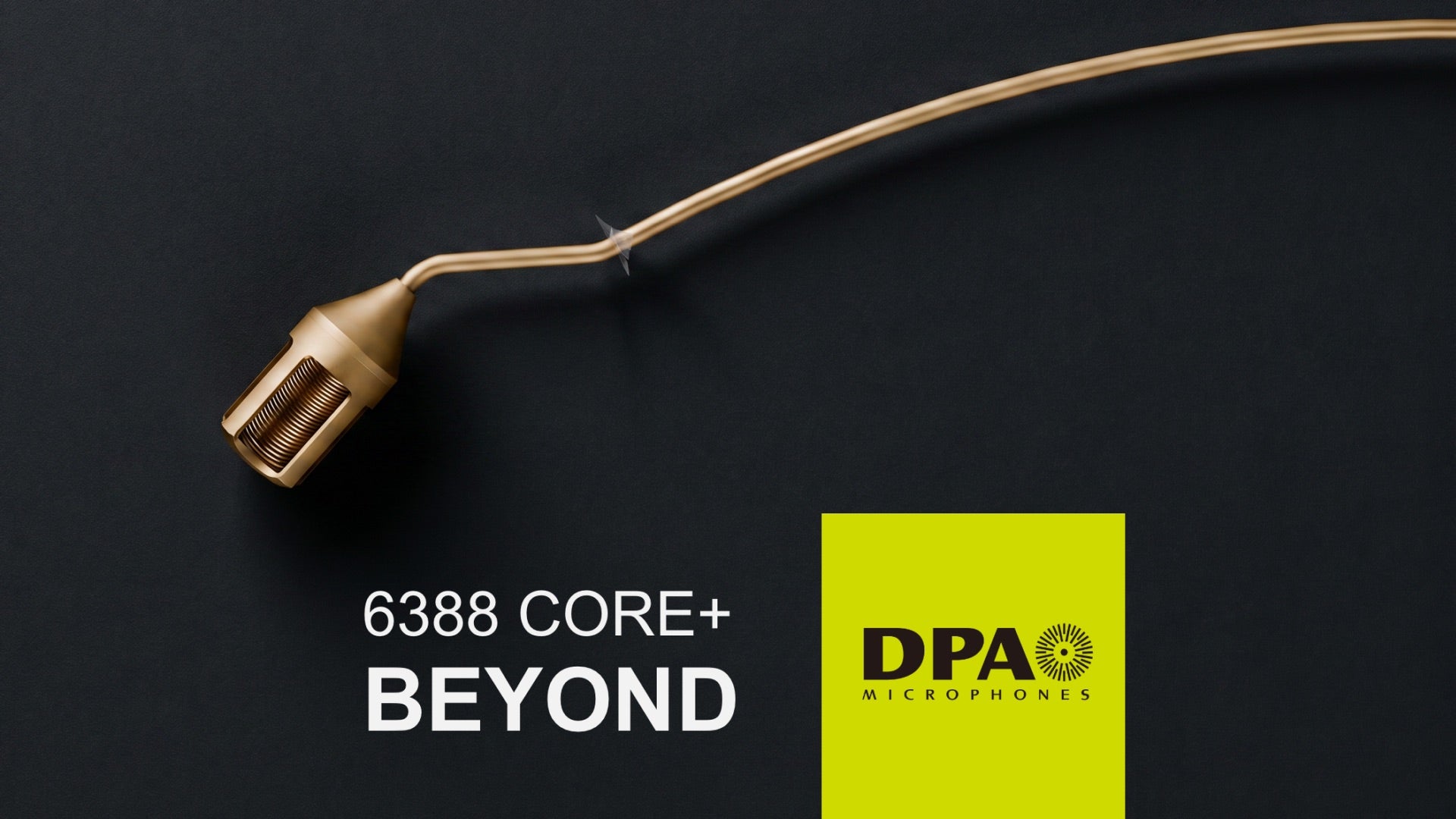
The new DPA 6388 CORE+ directional headset microphone was created for precisely these conditions. This supercardioid model is designed for theatre, live performance, television and radio broadcast, sports commentary, conferences and houses of worship.
DPA 6388 brings together a new directional capsule, CORE+ technology and the refined Act headset. The most important development, however, is not any single specification. The microphone was designed as a complete system in which the capsule’s directionality, acoustic axis, working distance and headset construction all work together.

When does a directional microphone become essential?
Omnidirectional headset microphones are valued for their natural sound and ease of use. In a quiet, well-controlled environment, they are often an excellent choice. The situation changes when ambient sound on stage increases, a performer moves closer to the loudspeakers or many microphones are used at the same time.
In these circumstances, a directional capsule helps reduce the amount of sound from monitors, instruments, other speakers and the audience that reaches the microphone signal. The sound engineer gets more of the intended voice and less of the stage environment, allowing the microphone to be brought to a higher level while reducing the risk of acoustic feedback.
DPA 6388 is a pre-polarised condenser microphone operating on the pressure-gradient principle. The difference between the sound reaching the front and rear of the capsule makes its directional characteristic possible, but it also makes the design more dependent on position, frequency and distance.
A directional headset microphone is not simply an omnidirectional model with a narrower pickup area. Its design requires many interrelated characteristics to be balanced: directionality at different frequencies, rejection of sound outside the primary axis, proximity effect, sensitivity to capsule position, self-noise, dynamic range and resistance to breath and wind noise.
Improving one characteristic can compromise another. A very narrow pickup area may help isolate the voice, but it can also make the microphone excessively sensitive to precise positioning. Making the capsule even smaller may increase self-noise or compromise directional control and wind resistance. A high maximum SPL alone also says nothing about how the microphone will perform with quiet speech.
The idea behind DPA 6388 is not to maximise one parameter, but to find a practical balance between all of them. In other words, it aims to provide the isolation of a directional microphone without some of the drawbacks that users would normally have to accept.
An angled acoustic axis: the capsule is not pointing where it appears to be
One of the most interesting features of DPA 6388 is its asymmetrical capsule design and angled acoustic axis. The microphone head may physically appear to point forwards, but the direction of maximum sensitivity is deliberately angled towards the mouth.
The microphone is optimised for use approximately 3 cm from the corner of the mouth – the so-called “smile corner”. This position keeps the capsule beside the mouth rather than directly in front of it. The microphone obscures less of the face, is not aimed directly into the airflow and remains better protected from breath noise and plosive consonants.
This design has another practical benefit. With a conventional directional microphone, even a small change in position can alter the level or tone of the voice. The acoustic design of DPA 6388 reduces this sensitivity, helping it deliver more consistent results for different users and in different fitting conditions.
This is particularly important in productions where many performers need to be prepared at the same time and microphones must be fitted quickly. There is not always enough time to adjust every capsule with millimetre precision and test it at length. Less dependence on an ideal position means both faster preparation and fewer unexpected changes in sound during a performance.
The recommended 3 cm distance still matters. Moving the capsule closer increases the low-frequency response through the proximity effect, which can make the voice sound fuller or excessively rich. Moving the microphone farther away reduces the low frequencies. DPA 6388 provides greater practical tolerance, but it does not eliminate the laws of acoustics.

Directionality matters beyond 1 kHz
A microphone’s directional characteristic is often described with a single word, such as cardioid or supercardioid. Its real-world behaviour, however, also depends on frequency. Two models with apparently similar polar-pattern specifications can react very differently on stage.
Some directional microphones gradually lose directionality at high frequencies. This allows more ambient sound to reach the capsule in precisely the frequency range that is important for speech clarity. DPA 6388 is designed to maintain controlled directionality across a wider frequency range, including the high frequencies.
The sound arriving away from the primary axis is equally important. If a microphone strongly reduces some frequencies at a particular angle while allowing others through, the ambient sound takes on an unnatural colouration. Such a signal can be more difficult to correct, and in a system with several open microphones it can make the overall mix even more complicated.
DPA 6388 is designed to reject sources outside its primary pickup direction while maintaining a more even frequency balance in the rejected sound. For the sound engineer, this means more predictable behaviour, a more natural-sounding ambience and a more stable system in challenging acoustic environments.
CORE+ technology works where the signal begins
The DPA 6388 capsule incorporates CORE+ by DPA technology. This is not digital audio processing or an effect applied later in the signal chain. The technology operates inside the microphone capsule itself – at the point where acoustic sound is converted into an electrical signal.
Speech and vocal levels are constantly changing. A quiet sentence may be followed immediately by a shout, or a calm dialogue by a powerful musical passage. The microphone must capture these changes accurately without introducing unnecessary distortion. DPA 6388 offers a typical dynamic range of 117 dB and a maximum peak SPL of 144 dB.
These figures show that the microphone can handle a very wide range of voice levels. The value of CORE+, however, is best understood by listening: lower distortion helps preserve the character of the voice, the clarity of consonants and its natural dynamics. The sound engineer can then shape the performer’s sound at the console instead of first correcting inaccuracies introduced by the capsule.
You can learn more about how this technology works in our article “DPA CORE+ technology”.
Why is the capsule not even smaller?
On stage and in front of cameras, the least visible microphone is often preferred, which naturally raises a question: why not make the directional capsule even smaller? The DPA 6388 microphone head measures Ø 6.3 × 13.3 mm. It is compact, but it was not designed to achieve the smallest possible dimensions at any cost.
A directional microphone needs a certain amount of physical volume to control directionality, self-noise, distortion, proximity effect and resistance to airflow. Reducing the capsule further would require compromises in precisely the areas for which a directional microphone is chosen.
The visual discretion of DPA 6388 is therefore achieved through more than simply reducing the capsule size. Its angled acoustic axis allows the capsule to be positioned beside the mouth, the non-reflective PVD finish reacts less to stage lighting, and the transparent headset retainers are less visible against skin and hair. This is a more practical approach than sacrificing acoustic performance to save a few millimetres.
A refined Act headset for everyday work
Even an excellent capsule cannot deliver consistent results if the microphone moves on the wearer’s head. DPA 6388 therefore uses the refined Act headset. This is not a completely new construction, but an evolution of the experience gained with the long-established 4066 and 4088 models, developed in response to practical user feedback.
The Act platform is designed for quick fitting and the most stable possible hold. The headset size, boom length and ear-hook shape can be adjusted, while the boom itself can be mounted on either the left or right side. The rigid frame helps maintain the chosen position even when the wearer is moving actively.
The revised ear-hook shape follows the natural contours of the head and ears more closely, while soft, rounded tips distribute pressure more evenly. Increased friction in the retainers helps preserve the selected adjustment, so the microphone does not need to be constantly repositioned.
Transparent retainers are less noticeable on camera and on the theatre stage. The PVD finish on the headset and microphone boom does not reflect bright stage lighting, while the cable is routed at a 90° angle at the rear. This reduces strain at sensitive points in the cable and allows it to be guided neatly downwards.
The complete assembly, including the cable and MicroLock connector, weighs approximately 15 g. The microphone capsule is rated IP58 for protection against dust and moisture – an important quality when working with perspiration, make-up, outdoor events and intensive everyday use.

A case designed for more than transport
In a large theatre production or broadcast, performance on the wearer is not the only consideration. It is equally important that a technician can quickly find the correct colour, capsule and connector version, and pack everything away safely after the event.
The updated zipped case supplied with DPA 6388 is slightly larger, so the microphone and accessories are not compressed. A transparent window makes it possible to identify the microphone type, colour and connector without opening the case, while a separate label pocket protects the identification from wear. An elastic strap secures the microphone quickly without additional moulded inserts.
It may not be the most impressive line in the specifications, but in everyday rental, theatre and broadcast work, details like these save time and reduce the risk of selecting the wrong variant.
Two sizes, three colours and four connectors
DPA 6388 is available in Standard and Small sizes. The size does not change the capsule, microphone boom or acoustic specifications – the difference lies in the geometry of the headset and how it fits the wearer’s head.
- Standard size is designed to fit most adults.
- Small size is intended for children and users who need a more compact-fitting headset.
Both headset sizes can be adjusted further. Choosing the correct size matters for more than comfort: a well-fitting headset helps the capsule maintain its intended distance and angle as the wearer moves or turns their head.
The microphone is available in black, brown or beige, allowing it to be matched to stage costumes, skin tone, hair or the filming environment. All three colours are offered in both sizes.
Four connector versions are available:
- MicroLock – DPA’s modular connector, used with a DPA adapter made for the relevant wireless system;
- 3-pin LEMO – for compatible transmitters with a 3-pin LEMO microphone input;
- TA4F Mini-XLR – for compatible transmitters with a 4-pin TA4F connector;
- Mini-Jack – a version with a locking 3.5 mm connector for compatible wireless transmitters.
The connector version must be selected according to the wireless transmitter in use. A similar-looking connector does not guarantee compatible pin wiring or power requirements, so it is worth checking before ordering if there is any uncertainty.
The choice of three colours, two sizes and four connector types creates 24 specific product variants. You can find every available version on the DPA 6388 CORE+ product page.

Where does DPA 6388 perform at its best?
Theatre and musical productions
A theatre production may use many wireless microphones at the same time, with actors constantly moving while the orchestra, stage monitors and other performers can all be heard nearby. Voice isolation matters, but so does achieving consistent results when performers change or a microphone must be prepared quickly. The directional capsule, greater positioning tolerance and stable headset address precisely these challenges. You can read more about other DPA solutions for this field in our article “Theatre with DPA Microphones”.
Live performance
For vocalists, presenters and stage performers, a headset microphone provides freedom of movement without having to hold a microphone. On a loud stage, however, an omnidirectional capsule may pick up too much from the monitors, instruments and the stage as a whole. The supercardioid characteristic of DPA 6388 helps keep the voice at the front of the mix, even in a challenging sound-reinforcement system.
Broadcast and sports commentary
The environment at a sporting event or live television broadcast is rarely quiet. The audience, event sound and people speaking nearby all compete with the commentator’s voice, and there is no time for corrections in post-production. Controlled directionality, speech intelligibility and the ability to achieve consistent results quickly are particularly valuable here. The non-reflective finish and visually discreet construction are also important on camera.
Conferences and houses of worship
In these spaces, the speaker is often close to the loudspeakers and may have little experience using a microphone. They may turn their head, touch the headset or fit the microphone imperfectly. Lower sensitivity to position changes and a stable fit help maintain more consistent results, while the directional capsule gives the sound-reinforcement system more room to operate.
Does DPA 6388 replace DPA 4088?
DPA 6388 is not simply a new name for 4088, nor is it intended to replace every earlier DPA directional model automatically. The 4088, 4288 and 4488 use a cardioid capsule, while the 6388 uses a more tightly focused supercardioid design with an angled acoustic axis.
The 4088 family remains relevant wherever its balance of directionality, size and construction best matches the task. The 6388 expands the choice for situations that require greater isolation, more stable operation close to loudspeakers and better control of directionality across a wider frequency range.
Both product families retain the natural sound associated with DPA, allowing them to be used in the same production. The key question is not simply which model is newer, but the acoustic environment in which it will be used.
The essence of DPA 6388: fewer compromises on a real stage
DPA 6388 CORE+ is compelling not because of a single record-breaking figure, but because of the way its different solutions complement one another. The supercardioid capsule helps isolate the voice, more consistent directionality preserves a more natural ambient sound, the angled acoustic axis provides greater freedom in positioning, and CORE+ technology accurately captures both quiet and extremely powerful voices.
The refined Act headset keeps this acoustic system where it was adjusted to be. The choice of colours, sizes and connectors allows the microphone to be matched to the individual performer and wireless system, while the redesigned case makes everyday work behind the scenes easier.
This is a professional tool for situations in which the audience should hear the person – not the technical work taking place around the microphone.
Explore DPA 6388 CORE+ colours, sizes and connector variants in the Stage IQ store.
If you are unsure which size or connector is compatible with your wireless microphone system, contact us at info@stageiq.lt or call +370 636 55536.
Stage IQ
Sound, lighting and stage solutions
Baltupio St. 71A, Vilnius
+370 636 55536
info@stageiq.lt


