

WiiM: From Compact Network Player to Home Theater System
In just a few years, WiiM has evolved from a niche product into a standard for those seeking high-quality home audio without compromising on price. Mini, Pro Plus, Amp Ultra, Sound, Sub Pro – each model addresses a specific need. In this article, we review the entire currently available WiiM lineup, what each device does, and how they fit together. You can find all WiiM devices at stageiq.lt.
Why WiiM Has Become the Most Popular Choice in the Home Audio Market
WiiM is developed by Linkplay Technology, founded by a team of engineers with experience from Broadcom, Google, and Harman. The company initially manufactured network audio modules for other brands, so WiiM entered the market not as a startup with an idea, but as professionals with a decade of experience. The result: devices that support all major protocols (AirPlay 2, Google Chromecast, Spotify Connect, Tidal Connect, Roon, DLNA, Amazon Music, Qobuz), feature one of the best-rated control apps in their category, and cost half as much as their equivalent competitors.
The WiiM Home app (iOS and Android) is a big part of why these devices are so well received. It's fast, stable, and controls everything from volume levels to room acoustic correction and parametric EQ. Configuring each WiiM device takes about 10 minutes for a new user.
WiiM Mini: Smallest, Cheapest, but Not Limited
 WiiM Mini: compact network player with AirPlay 2, Chromecast, and optical connection
WiiM Mini is a round, palm-sized network player with an optical port (SPDIF in/out), a 3.5 mm AUX input and AUX output, USB-C for power, and an Ethernet port. It supports AirPlay 2, Bluetooth, Spotify Connect, and WiiM multiroom. It lacks analog RCA outputs, so it connects directly to an amplifier only via an optical cable or Bluetooth.
The Mini is the best choice when your amplifier already has an optical input, when you need to add network audio to your TV (via optical), or when you simply need the smallest and cheapest WiiM solution. It's perfect as a multiroom companion speaker or as a solution for a second room.
WiiM Pro and WiiM Pro Plus: Two Models, a Clear Difference
 WiiM Pro Plus with AKM 4493SEQ DAC, voice remote control, and Room Ready support
WiiM Pro is the first model with analog RCA outputs and a coaxial digital output. This provides a versatile connection for any amplifier. It also features an analog RCA input, allowing you to digitize a turntable or any other analog source and transmit it over the network. Supports AirPlay 2.
WiiM Pro Plus is a significant step up: it incorporates an AKM 4493SEQ digital-to-analog converter, a TI Burr-Brown PCM1861 ADC, an eight-band parametric EQ, room acoustic correction, Roon Ready, and a voice remote control. What Hi-Fi? magazine called the Pro Plus "almost unbeatable at its price" and noted that to get better sound, you'd have to spend significantly more. Pro Plus supports AirPlay 2.
Both models support AirPlay 2, Google Chromecast, DLNA, Spotify Connect, Tidal Connect, Qobuz, Deezer, Amazon Music, TuneIn, and many other platforms, as well as Alexa and Google Assistant voice control.
WiiM Ultra: One Device for Everything
WiiM Ultra is the highest-end non-amplifying streamer model. Compared to the Pro Plus, the Ultra adds: a 3.5-inch color touchscreen, an HDMI ARC input for TV, a moving magnet (MM) phono preamplifier for a turntable, a 3.5 mm headphone output, and an ESS ES9038Q2M SABRE digital-to-analog converter with an SNR over 120 dB. This isn't a source you hide, but a central audio hub: it controls TV sound, plays vinyl, displays album art on its screen, and synchronizes the entire home system.
An important note: WiiM Ultra does not support AirPlay 2 due to hardware limitations, and this will never change in this version of the model. If AirPlay and the Apple ecosystem are a necessity, the WiiM Pro Plus is a more suitable choice.
WiiM Amp, Amp Pro, and Amp Ultra: Network Amplifiers
 WiiM Amp Ultra: 100W/8Ω and 200W/4Ω network amplifier with HDMI ARC, ESS DAC and Wi-Fi 6
The WiiM Amp series is a solution for those who want passive speakers and network audio but don't want a separate amplifier and a separate network player. One compact device performs both functions.
WiiM Amp : 60W/channel into 8Ω, HDMI ARC, optical and RCA inputs. Supports AirPlay 2.
WiiM Amp Pro : an updated version with ESS ES9038Q2M DAC (SNR 120 dB, THD+N -105 dB), Wi-Fi 6 with two antennas, and PFFB (Post-Filter Feedback) technology, stabilizing amplifier performance with varying speaker impedance. Power is the same: 60W/8Ω, 120W/4Ω. AirPlay 2 is not supported.
WiiM Amp Ultra (newest model, 2025): significant power jump – two TI TPA3255 Class D amplifier chips and six TI OPA1612 op-amps, 100W/8Ω and 200W/4Ω. ESS ES9039Q2M SABRE DAC, 3.5-inch touchscreen with album art and VU meters, aluminum chassis, Wi-Fi 6, Bluetooth 5.3. Darko.Audio reviewer rated it as significantly better than Amp Pro in bass dynamics and treble purity. AirPlay 2 is not supported.
WiiM Sound: The First WiiM Speaker

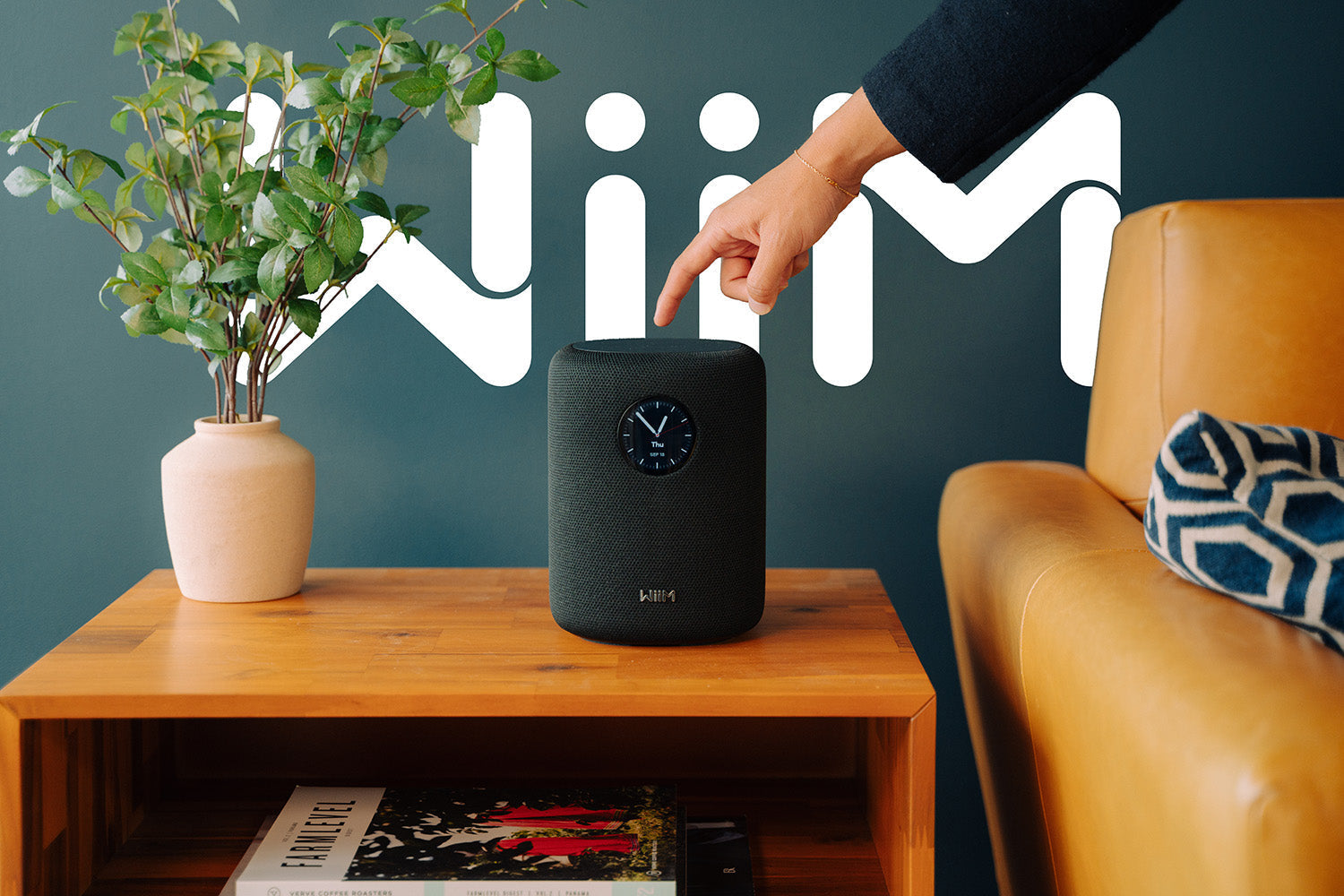
WiiM Sound is the first active speaker produced by WiiM itself. It's a compact device with 100W total power, a 4-inch woofer and two balanced tweeters, a 1.5-inch touchscreen on the front, 24-bit/192 kHz support, and room acoustic correction via the WiiM Home app. Connectivity includes Wi-Fi 6E, Bluetooth 5.3, Ethernet, and a 3.5 mm AUX input.
WiiM Sound can be paired in stereo, used as a home theater side or center channel, or integrated into a multiroom system with other WiiM devices. It directly competes with the Apple HomePod and Google Nest Audio segment, but does not support AirPlay 2.
WiiM Sub Pro: The First WiiM Subwoofer
WiiM Sub Pro is the first WiiM subwoofer: with an 8-inch driver, a 250W Class D amplifier, a 25 Hz – 200 Hz frequency range with less than 1% THD+N. It supports Wi-Fi/Ethernet network audio streaming and room acoustic correction via the WiiM Home app, meaning it can be used completely wirelessly without any physical connection to an amplifier or player. An RCA input is also available for traditional connection.
The Sub Pro is best suited as an addition to WiiM Sound speakers or WiiM Amp/Amp Pro/Amp Ultra systems, but can also work with any other system via an RCA connection. It's an important addition to the WiiM ecosystem, filling the last gap for those who wanted a complete WiiM home system.
How to Choose a WiiM Device
You already have an amplifier and passive speakers: WiiM Pro Plus is the best choice for most. If you need AirPlay 2 (Apple ecosystem) – Pro Plus or Pro specifically. If AirPlay is not needed and you want the best sound quality and a phono input – WiiM Ultra.
You don't have an amplifier and want a single device: WiiM Amp (if you need AirPlay 2), WiiM Amp Pro (if sound and stability are priorities), or WiiM Amp Ultra (if you need serious power and a display). Simply connect passive speakers to any of them.
You want a compact active speaker: WiiM Sound, especially as a pair. Adding a Sub Pro will give you a full home system package without a separate amplifier.
Multiroom system: Any WiiM device acts as a multiroom hub via the WiiM Home app. Additionally, you can sync with Amazon Echo, Google Nest, and (in certain models) Apple HomePod via AirPlay 2.
Important note about AirPlay 2: WiiM Mini, Pro, Pro Plus, and Amp support AirPlay 2. WiiM Ultra, Amp Pro, Amp Ultra, and Sound do not support AirPlay 2 due to hardware limitations. If Apple Music or HomePod integration is a priority, choose from the first group.
WiiM vs Sonos: What's the Difference
Sonos is the most well-known multiroom alternative. The practical difference: WiiM works with existing passive speakers and amplifiers, while Sonos systems typically require purchasing Sonos active speakers. Buying a WiiM streamer or Amp allows you to leverage your existing hi-fi equipment. The Sonos app received a lot of criticism in 2024 after a complicated update, while the WiiM Home app was consistently improved during the same period and is now a standard in its category.
You can find the entire WiiM range at stageiq.lt/collections/wiim.
Can't find the WiiM product you're looking for? Contact us: info@stageiq.lt or +370 636 55536


