

How a DPA Microphone Became Part of History
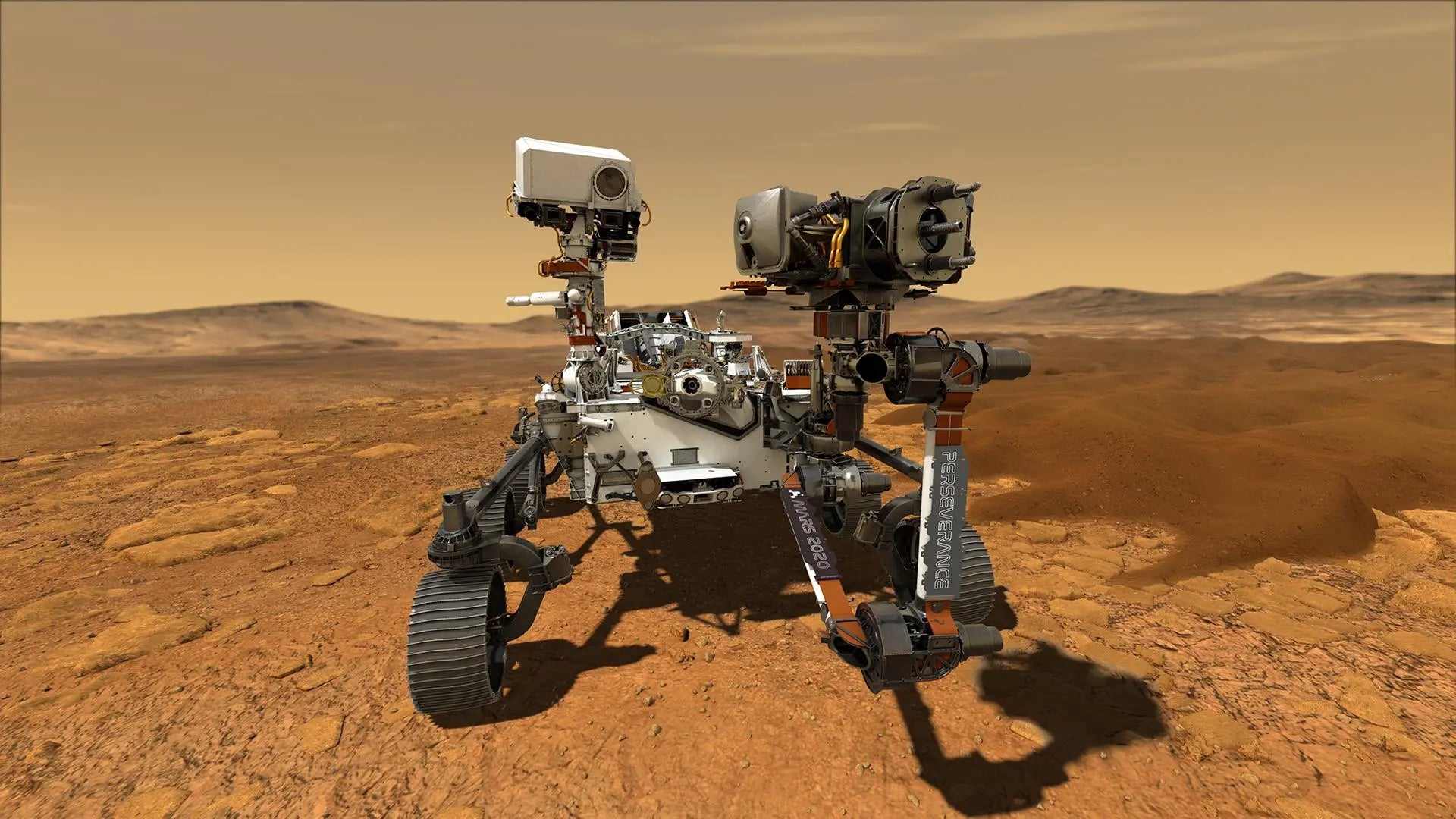
When did you first hear the wind? On Earth, it's an everyday sound that we take for granted. But in 2021, humanity heard the wind anew. Only this time – from Mars. It was the first time in history that any sound was recorded and transmitted from another planet.
And here's what excites us the most. This historic sound fragment was captured by technology that we represent here in Lithuania, Stage IQ. These are DPA Microphones – some of the most accurate and reliable microphones in the world.
For a microphone to work beyond Earth, it must withstand extreme conditions, be incredibly sensitive, and yet reliable. And DPA proved it.
Hear the Real Sound of Mars
This is an official NASA Perseverance recording. A filtered version without the rover's mechanical sounds, allowing you to hear only the rustling of the Martian wind.
How Sound Travels on Mars: Cosmic Acoustics
Sound travels completely differently on Mars than on Earth. This is not just a poetic comparison – it's physics.
- Mars' atmosphere is only 1.2 percent of Earth's density.
- It is composed mostly of carbon dioxide (about 95 percent).
- Sound travels at 240 m/s (on Earth – 343 m/s).
- High frequencies (above 2 kHz) disappear very quickly due to the lack of density.
- Low frequency attenuation is smaller, so the recording sounds "muffled."
- Temperatures from –90 to –10 degrees significantly alter sound propagation.
In other words, if a voice sounds clear on Earth, on Mars it would be as if recorded through a thin filter. For these reasons, it is extremely difficult for a microphone to work there.
The First Microphone on Another Planet
The Perseverance rover is only the second spacecraft to have a real sound recording system. The first was the Phoenix lander in 2008, but its microphone was never turned on due to technical risks.
The Perseverance microphone is the first operational sound recording device on another planet. DPA technology became the reason why this recording was possible at all.
Why NASA Chose DPA Microphones
NASA selected the microphone based on several key criteria:
- Sensitivity, allowing the capture of extremely weak signals in a thinner atmosphere.
- Very low self-noise.
- Accurate frequency response, minimally altering the real sound.
- Resistance to temperature fluctuations and vibration.
- Ability to integrate into the rover's electronics and protect from dust.
The DPA 4006 capsule technology met all these criteria. NASA modified the outer casing, added dust filters, thermal protection, and a special pressure equalization mechanism, but the core of the microphone capsule remained DPA.

DPA Microphones Technical Features That Helped Record Mars
The specifications of the DPA 4006 capsules (used as the basis for NASA's modification) are impressive:
- Frequency response: 20 Hz – 20 kHz
- Noise level: only 15 dB(A)
- Sensitivity: ~40 mV/Pa
- Maximum SPL: about 147 dB
- Capsule type: true omni type, very accurate and natural sound
- Construction: extremely low phase distortion
- Stability: thermally corrected, extremely stable frequency response
These features allow the microphone to accurately capture even very subtle acoustic changes. This is one of the reasons why DPA is used in symphony orchestras, the film industry, and scientific experiments.
What Else the DPA Microphone Recorded on Mars
Mars doesn't just sound like wind. The DPA microphone helped the rover record:
- laser spectrometer shots into Martian rocks;
- dust and sand moving around the rover;
- micro-vibrations during landing;
- rover mechanics diagnostics (sounds of engines, wheels, and tools).
This helps scientists analyze both Martian geology and the condition of the rover itself.


Stage IQ and DPA Microphones in Lithuania
Stage IQ is the official representative of DPA Microphones in Lithuania. This means that the technology NASA trusts can be purchased right here in Lithuania.
We work with:
- theaters and concert halls;
- TV and film recording teams;
- universities and scientists;
- sound engineers and creators;
- broadcast and event organizers.
DPA Microphones stand out because their reproduction accuracy is so high that the microphone almost does not change the real sound. This allows it to be used in situations where absolute quality is mandatory – from a symphony to a space mission.
Conclusion
The first sound from Mars is more than a scientific achievement. It is a moment when technology, human curiosity, and professional sound merged into one story. And at its center – a microphone that can be purchased in Lithuania today.
If you want to learn more about DPA Microphones, their differences, model applications, or professional solutions, we invite you to visit the Stage IQ showroom in Vilnius, Baltupio g. 71A, or contact us. We will help you choose equipment that can capture both a choir on stage and the wind on another planet.


