

STAGE IQ Articles
STAGE IQ Articles

DPA CORE+ Technology
DPA CORE+ Technology: Why Small Improvements Make a Big Difference In professional audio technology, it's usually not the most striking solutions that win, but those that allow for stable, predictable, and uneventful work. Most experienced audio specialists know that the difference between "good" and "very good" sound often lies not in obvious things, but in subtleties that only become apparent during prolonged use. DPA CORE+ technology is precisely such an improvement. It doesn't change the microphone's sound, alter its frequency range, or add any "character." Instead, it addresses a very specific, but often unstated problem – how precisely the microphone transmits a signal when the sound is constantly changing. In this article, we will explain what CORE+ technology is, how it differs from the previous CORE version, and why this difference is genuinely audible when working with speech, vocals, acoustic instruments, in theatre, and in broadcasting. Why Specifications Don't Always Tell the Whole Story When choosing a microphone, technical characteristics such as noise level, maximum sound pressure, and frequency range are usually considered. These are important parameters, but in practice, it often happens that two microphones with very similar specifications behave differently in real-world use. One might sound clearer and more stable, while the other might require more corrections, quickly "fatigue" the listener, or struggle with dynamic speech. These differences often cannot be explained solely by the numbers in a specification table. In practice, this relates to how the microphone capsule behaves with a fluctuating signal. Speech, vocals, or acoustic instruments never sound even – the sound constantly changes, with quiet and sudden moments occurring. It is in such situations that the microphone's accuracy, or lack thereof, becomes apparent. What CORE Technology Was CORE technology was DPA's response to this problem. Its goal was to improve the capsule's performance in dynamic situations and reduce microphone-introduced inaccuracies that arise not from overload, but from the capsule's own behavior. In practice, this yielded a very clear result: the sound became more stable, less "broken" in quiet passages, and when working with speech, the need for aggressive EQ correction or strong compression just to make the signal intelligible was reduced. For many professionals, this was already a sufficient improvement. However, when working in complex acoustic situations, there remained areas where the capsule's behavior could still be enhanced. What CORE+ Technology Is CORE+ technology is a further step in the same direction. It is not digital processing, it is not DSP, and it is not any "post-recording signal correction." CORE+ operates within the microphone capsule itself – where sound is first converted into an electrical signal. The main goal of CORE+ is to transmit a fluctuating signal even more accurately in complex situations, especially when very quiet moments overlap with sudden changes in sound. It was in such areas that previous capsules could sometimes behave less stably. CORE+ allows the capsule to work more smoothly, so the microphone "loses control" less in dynamic passages. This is not an effect you will always hear in the first minute, but it is very clearly felt during prolonged use. How This Sounds in Real-World Use Audio specialists usually describe the effect of CORE+ very simply: it's easier to work with such a microphone. The sound remains clearer, more stable, and more predictable, especially when working with speech or live vocals. This is especially important in theatre, broadcasting, and events where sound must be intelligible not just for a brief moment, but for a long time. A lower amount of microphone-introduced inaccuracies means less listener fatigue and less stress for the sound engineer themselves. Why CORE+ Is Particularly Relevant for Small-Format Microphones In small-format microphones, physical compromises are inevitable. Due to the small size of the capsule, any inaccuracy becomes audible more quickly than in large studio microphones. CORE+ technology allows such capsules to operate in a more stable zone, making them more reliable in everyday, complex situations – from theatre performances to live broadcasts or live sound events. Conclusion: Why CORE+ Is Important in Practice CORE+ technology is not a solution that fundamentally changes the microphone's sound or makes it "different." It does not change the frequency range, add character, or create an effect. Instead, it does what is often most important in professional audio technology – it helps the microphone work more accurately and stably in real, dynamic conditions. Such improvements are most valued not in short tests, but in daily work: in long performances, broadcasts, events, or complex acoustic spaces. A lower amount of microphone-introduced inaccuracies means not only clearer sound but also less fatigue for both the listener and the sound specialist. This is precisely why CORE+ technology is not designed "to create an impression." It is intended for those who value a predictable, reliable result and the ability to focus on content, rather than constantly solving technical problems. This is the main reason why such seemingly small technological improvements eventually become the standard in a professional environment. Stage IQAudio, lighting and stage solutions Address: Baltupio g. 71A, VilniusEmail: info@stageiq.lt

Sound Solutions for Schools
When a School's Sound System No Longer Meets Current Needs School events seem simple at first glance. Children prepare for performances, teachers set up the program, parents gather in the hall. In such situations, sound should not be a separate issue. It just needs to work and not interfere with the event itself. Most of the time, this is how it works. However, over time, a feeling emerges that the system requires more attention than desired. Before events, more time has to be spent on preparation, checking settings, and adapting on the spot. This is not a malfunction or a critical problem, but a clear signal that the system no longer meets current needs. This is a natural situation that many schools face. A System Designed for a Different Era A large proportion of school sound systems were installed based on the solutions and technologies available at the time. They were functional, reliable, and met the requirements of the time. The system worked and fulfilled its purpose. However, technology does not stand still. The logic of solutions, control principles change, and greater expectations for stability and simplicity arise. Equipment that was installed many years ago often still works today, but it no longer offers the predictability and comfort that is now taken for granted. This does not mean that previous solutions were inadequate. It means they were designed in a different technological context. Not a Malfunction, but Natural Aging An outdated sound system is usually not broken. It turns on, transmits sound, and allows for use in everyday situations. However, its operation becomes less stable and more dependent on manual adjustment. In some cases, the volume needs to be adjusted more frequently, adapted to the room or situation, and potential changes during the event need to be anticipated. None of this is unusual, but over time it becomes a sign that the system no longer meets current use. It is important to understand the difference between repair and upgrade. A malfunction is solved by replacing a part. Obsolescence is solved by reviewing the entire solution. The Same Systems in Different Spaces School sound systems are often used in different rooms. In the assembly hall, sports hall, or other common areas. Although the function remains the same, each space "receives" sound differently. Using the same solutions for a long time makes it clear that the system does not behave uniformly everywhere. In one room, it works smoothly, in another, it requires more adjustments. This is not unexpected, but it shows that the system was designed without the ability to adapt to different acoustic conditions. Modern solutions allow such adaptation to be foreseen in advance. When Technology Starts Demanding Attention One of the clearest signs that a system is outdated is that the technology becomes more visible. Before events, additional actions, more preparation, and more manual control are required. This does not necessarily hinder, but it changes the feeling of use itself. The system is no longer a background, but a separate element that requires attention. In a school environment, this is especially important because different people use the equipment, and not all of them work with it constantly. A reliable system is one that works predictably and does not require additional on-the-spot solutions. Upgrade as a Sequential Process Upgrading a sound system is often perceived as a major change, but in practice, it is often a sequential process. First, the current situation is assessed, then the parts that no longer meet current needs are identified, and solutions are planned in stages. It is not always necessary to change everything at once. Sometimes it is enough to review the system's logic, control, or layout. This approach allows for rational planning of the upgrade and avoids hasty decisions. The most important thing is to view the system as a whole, and not as a collection of separate components. When Sound Becomes Unnoticed Again An updated sound system, adapted for current use, usually ceases to be a separate issue. It operates stably, predictably, and does not require constant attention. Speech is heard throughout the space, music sounds even, and the course of the event does not depend on technical solutions on the spot. In this case, the sound performs its function and does not become an additional task. This is the main goal of upgrading a school's sound system. Conclusion If a school's sound system requires more attention today than before, it does not necessarily mean a problem. Very often, it is simply a sign that the system was designed according to different technical standards and different solution logic. A timely reviewed and thoughtfully updated solution allows the school to work calmly and consistently. Then the sound once again becomes what it should be – a natural, unnoticed part of school events. Stage IQSound, lighting, and stage solutions for educational institutions Address: Baltupio g. 71A, VilniusEmail: info@stageiq.lt

First Sound from Mars
How a DPA Microphone Became Part of History When did you first hear the wind? On Earth, it's an everyday sound that we take for granted. But in 2021, humanity heard the wind anew. Only this time – from Mars. It was the first time in history that any sound was recorded and transmitted from another planet. And here's what excites us the most. This historic sound fragment was captured by technology that we represent here in Lithuania, Stage IQ. These are DPA Microphones – some of the most accurate and reliable microphones in the world. For a microphone to work beyond Earth, it must withstand extreme conditions, be incredibly sensitive, and yet reliable. And DPA proved it. Hear the Real Sound of Mars This is an official NASA Perseverance recording. A filtered version without the rover's mechanical sounds, allowing you to hear only the rustling of the Martian wind. Your browser does not support the audio player. How Sound Travels on Mars: Cosmic Acoustics Sound travels completely differently on Mars than on Earth. This is not just a poetic comparison – it's physics. Mars' atmosphere is only 1.2 percent of Earth's density. It is composed mostly of carbon dioxide (about 95 percent). Sound travels at 240 m/s (on Earth – 343 m/s). High frequencies (above 2 kHz) disappear very quickly due to the lack of density. Low frequency attenuation is smaller, so the recording sounds "muffled." Temperatures from –90 to –10 degrees significantly alter sound propagation. In other words, if a voice sounds clear on Earth, on Mars it would be as if recorded through a thin filter. For these reasons, it is extremely difficult for a microphone to work there. The First Microphone on Another Planet The Perseverance rover is only the second spacecraft to have a real sound recording system. The first was the Phoenix lander in 2008, but its microphone was never turned on due to technical risks. The Perseverance microphone is the first operational sound recording device on another planet. DPA technology became the reason why this recording was possible at all. Why NASA Chose DPA Microphones NASA selected the microphone based on several key criteria: Sensitivity, allowing the capture of extremely weak signals in a thinner atmosphere. Very low self-noise. Accurate frequency response, minimally altering the real sound. Resistance to temperature fluctuations and vibration. Ability to integrate into the rover's electronics and protect from dust. The DPA 4006 capsule technology met all these criteria. NASA modified the outer casing, added dust filters, thermal protection, and a special pressure equalization mechanism, but the core of the microphone capsule remained DPA. DPA Microphones Technical Features That Helped Record Mars The specifications of the DPA 4006 capsules (used as the basis for NASA's modification) are impressive: Frequency response: 20 Hz – 20 kHz Noise level: only 15 dB(A) Sensitivity: ~40 mV/Pa Maximum SPL: about 147 dB Capsule type: true omni type, very accurate and natural sound Construction: extremely low phase distortion Stability: thermally corrected, extremely stable frequency response These features allow the microphone to accurately capture even very subtle acoustic changes. This is one of the reasons why DPA is used in symphony orchestras, the film industry, and scientific experiments. What Else the DPA Microphone Recorded on Mars Mars doesn't just sound like wind. The DPA microphone helped the rover record: laser spectrometer shots into Martian rocks; dust and sand moving around the rover; micro-vibrations during landing; rover mechanics diagnostics (sounds of engines, wheels, and tools). This helps scientists analyze both Martian geology and the condition of the rover itself. Stage IQ and DPA Microphones in Lithuania Stage IQ is the official representative of DPA Microphones in Lithuania. This means that the technology NASA trusts can be purchased right here in Lithuania. We work with: theaters and concert halls; TV and film recording teams; universities and scientists; sound engineers and creators; broadcast and event organizers. DPA Microphones stand out because their reproduction accuracy is so high that the microphone almost does not change the real sound. This allows it to be used in situations where absolute quality is mandatory – from a symphony to a space mission. Conclusion The first sound from Mars is more than a scientific achievement. It is a moment when technology, human curiosity, and professional sound merged into one story. And at its center – a microphone that can be purchased in Lithuania today. If you want to learn more about DPA Microphones, their differences, model applications, or professional solutions, we invite you to visit the Stage IQ showroom in Vilnius, Baltupio g. 71A, or contact us. We will help you choose equipment that can capture both a choir on stage and the wind on another planet.

Choosing a Guitar Amplifier
Guitar Amplifiers: How to Choose the Right Combo Amp and Understand Their Differences A guitar amplifier – often simply called a combo amp – is one of the most crucial elements in an electric guitar's sound. While the guitar itself determines the tonal direction, it is the amplifier that gives the sound body, dynamics, character, and volume headroom. Let's be honest: even an expensive guitar will sound weak if connected to an unsuitable or poorly chosen amplifier. Therefore, understanding how different combo amps work and what distinguishes them is very important for both beginners and experienced musicians. In this article, we will clearly and without excessive technical jargon explain what a guitar amplifier consists of, what types are most popular, how their construction affects the sound, and how to practically choose a model according to your needs. We will use real models available on the market for examples, including Fender amplifiers available at Stage IQ, but only as contextual examples, not promotional content. 1. What a Guitar Amplifier Consists Of Any guitar amplifier – whether a small practice combo or a large stage model – operates according to the same basic scheme. It consists of three main sound-shaping parts: Preamp (Preamplifier) This is the part that determines most of the tonal character: clean sound, overdrive, gain, EQ, and other aspects. This is where the overall guitar tone is formed. Whether you like a clean sound, a warm crunch, or a stronger drive – the preamp is responsible for it. Many amplifiers have built-in effects such as chorus, delay, or reverb, which are also considered part of the preamp section. Power Amp (Power Amplifier) This part not only amplifies the signal created by the preamp to speaker level but also influences the dynamic response. A more powerful power stage provides more headroom, allows you to increase the volume without distortion, and often gives the sound more "freedom." This is especially noticeable in tube amplifiers, but the power amp also plays a clear role in solid-state amps. Speaker The speaker is to an amplifier what an acoustic guitar is to a guitarist – it dramatically changes the tone. Different sizes provide different sounds: 8 inches – fast, sharper tone, more suitable for home and practice; 10 inches – more versatile, balanced sound; 12 inches – stage standard, deeper lows, more solid projection. Therefore, two amplifiers with the same preamp but different speaker sizes can sound completely different. 2. Main Types of Guitar Amplifiers Modern guitar combo amps can be divided into three main categories: digital, solid-state, and acoustic. Each has its advantages and most suitable uses. Digital Amplifiers Digital amplifiers are very versatile. They use modeling to emulate the character of different classic amplifiers. This is especially useful for beginners and those who want a wide range of tones in one device. For example, the Fender Champion 25 is a well-known practical solution for home: simple controls, clean Fender tones, chorus, reverb, light overdrive. Meanwhile, the Fender Champion 50XL provides more power and a deeper bass response due to its 12-inch speaker – a more robust choice for rehearsal spaces or small stages. Digital combo amps are suitable for various styles, as one device can create everything from clean to drive. Solid-State Amplifiers Solid-state amplifiers are characterized by reliability, lightness, and consistent sound quality. They require no maintenance, do not wear out like tubes, and are perfect for those who travel a lot, play in rehearsals, or want a stable tone. One popular market example is the Fender Rumble 40. Although it is a bass amplifier, it clearly demonstrates the advantages of solid-state combos: powerful, clean, light, and very versatile. Such models are favored by musicians who want a clear sound and simple operation. Acoustic Guitar Amplifiers An acoustic guitar requires a completely different amplifier than an electric one. Acoustic amplifiers are designed for natural tone reproduction, amplifying the instrument without coloring it. Many of them have two channels – for guitar and vocals. The Fender Acoustic Junior Go is a good example for performers who play acoustic guitar and sing. It has a rechargeable battery, so you can play anywhere – from a park to an event without electricity. Such amplifiers are especially convenient for mobile performers. 3. How to Choose the Right Combo Amp Power One of the most common mistakes is choosing too much power for home use. Power determines not only loudness but also sound headroom. At home, rarely do you need more than a 20–30 W solid-state or digital amplifier. 15–25 W – suitable for home and individual practice. 30–50 W – a good choice for band rehearsals. 50 W+ – for small stages, events. Also remember: a 12-inch speaker will provide more bass and projection, so sometimes even a lower-wattage amplifier can sound "fuller" than a higher-wattage model with a smaller speaker. 4. Common Mistakes When Choosing a Guitar Combo Amp Too much power for home. An amplifier will sound best when it "breathes," not at very low volumes. Too small a speaker for rehearsals. 8-inch speakers often don't fill a room. Confusing digital and solid-state amplifiers. These are different technologies with different tonal philosophies. Underfinancing the tone. Some musicians choose only by wattage, not by tone. Not trying it live. Documentation and videos cannot replace the impression from a real speaker. 5. Why You Should Try an Amplifier Live Amplifiers are not universal – two people can play the same model but sound completely different. The differences are determined by playing dynamics, guitar type, effects, and even string choice. Therefore, the best way to understand if an amplifier is right for you is to listen with your own ears. At the Stage IQ showroom, you can try various combo amps live with your own guitar or with instruments available on-site. This helps to clearly understand the real sound, not just theoretical parameters. Where to Find Stage IQ Visit our showroom and compare different guitar amplifiers: Stage IQBaltupio g. 71A, Vilnius

Solid Wood or Laminate
Solid Wood or Laminate? Which to Choose for a Beginner's Acoustic Guitar? If you're just starting to learn to play the guitar, you've probably already encountered many new terms. One of the first questions almost every beginner faces is: what's the difference between solid wood and laminate? And is it worth paying extra for solid wood, or is a simpler but reliable option enough? While the construction details might sound technical, they are actually very practical. Different guitar constructions determine the sound, comfort, durability, and how much you'll want to play it every day. The following article will help you easily understand the essential differences and choose the instrument that's right for you. The text is adapted based on Stage IQ's current assortment and the real guitar constructions you'll find in our store. Why Is Guitar Construction Important at All? In an acoustic guitar, sound is created not by electronics, but by the wood itself. The top of the body, which vibrates the most, is especially important. Therefore, it largely determines the guitar's character: whether the sound will be warm, bright, open, or quieter. For this reason, the most important thing for beginners to understand is one simple fact: a solid top usually sounds richer and livelier, while a laminated top is more durable and cheaper. Solid Wood – a Livelier and More Responsive Sound A solid wood guitar is often the first serious step for someone who wants better sound. A solid top vibrates more naturally, making the instrument respond more sensitively to your touch. When playing softly, the sound remains clear; when playing louder, richness and control are maintained. Such an instrument can inspire you to play more often simply because it sounds so pleasant. Another advantage of solid wood is that the sound improves over time. The wood opens up, dries, and becomes even livelier. This is one of the main arguments for people who want an instrument for the long term. However, solid wood is somewhat more sensitive to the environment. If the guitar is kept in a very dry room or frequently travels between different temperatures, it can react. Therefore, it's worth having a case and at least minimal care for a solid wood guitar. Laminate – a Sturdy, Stable, and Practical Construction Laminate guitars are an excellent choice for beginners who want a reliable instrument without a large investment. Laminate is less sensitive to temperature changes and humidity, making such a guitar perfect not only for home but also for travel, rehearsals, camps, or outdoor concerts. A laminate top usually sounds simpler and less dynamic than a solid top. However, for a beginner, this is often not a disadvantage – the most important thing is that the instrument is comfortable, stable, and durable. Laminate allows you to get a quality guitar at a more budget-friendly price, and you can play it confidently without fear that every environmental change will harm the instrument. Hybrid Construction – the Most Popular Choice for Beginners In the Stage IQ assortment, you will often find guitars that have a solid top and laminated sides and back. This is an excellent balance between good sound and practicality. A solid top provides a richer tone, clearer projection, and more vibrancy. Laminated sides and back maintain sturdiness, resistance to environmental changes, and reduce the price. Such guitars are especially suitable for beginners who: want a more beautiful sound than a full laminate provides; want an instrument that doesn't require special care; are looking for the best price-to-sound ratio. Often, it is precisely this hybrid construction that becomes the first more serious instrument, sounding inspiring and serving for many years. How to Choose If You Are a Beginner? If You Mainly Play at Home A solid-top guitar will offer more nuances and warmth. It responds better to your playing style and helps you hear the differences more quickly. If the Guitar Will Travel with You Laminate is the most reliable option. It withstands temperature changes, travel, transportation, and more intensive use. If You Want a Universal Solution A solid top with laminated sides is an optimal choice for many beginners. Such a guitar sounds beautiful but is not overly sensitive to the environment. If You Don't Yet Know If Playing Guitar Will Be a Long-term Activity Starting with a laminate or hybrid guitar is very sensible. Later, if playing becomes a serious part of your daily life, you can always upgrade to a full solid wood instrument. In Conclusion Solid wood and laminate are not just technical terms. They represent different instrument characters. Solid wood is suitable for those who want a soulful, open, and warm sound. Laminate is suitable for those who value practicality and durability. Hybrid construction is suitable for most beginners, as it combines both worlds. If you want to hear the difference between solid wood and laminate guitars for yourself, visit the Stage IQ showroom in Vilnius, Baltupio g. 71A. You'll be able to try out different models, feel their character, and choose the guitar that truly suits you, and not just based on the description.

DPA 4099 CORE+
DPA 4099 CORE+: The True Voice of the Instrument Date: 2025-11-12Category: Microphones, Pro AudioAuthor: Stage IQ team The New Standard for Instrument Recording DPA Microphones has introduced the 4099 CORE+, a new generation instrument microphone featuring state-of-the-art CORE+ technology. This is not a cosmetic update but a fundamentally re-engineered design that elevates instrument sound reproduction to an unprecedented level, both on stage and in the studio. The new version replaces the previous 4099 Core model. As of June 11, 2025, all 4099 microphones will be manufactured exclusively with CORE+ technology. This is a hard transition in the production process, and there will be no more mixed versions. What Is CORE+ Technology? CORE+ is a revolutionary electronics platform that virtually eliminates distortion across the microphone's entire dynamic range. The remaining traces of distortion become almost immeasurable and inaudible to the human ear. This precision delivers impeccable audio clarity even in the most demanding conditions, from the quietest violin phrases to the loudest trumpet solos. The 4099 CORE+ Loud SPL variant (6 mV/Pa) now achieves a peak SPL of 145 dB. The Extreme SPL version (2 mV/Pa) reaches up to 152 dB SPL. The dynamic range has been extended to 118 dB, and distortion has been reduced to less than 0.5% at 120 dB SPL. Acoustic Design and Directionality The 4099 CORE+ retains its supercardioid polar pattern but now features a smoother off-axis response and even stronger noise rejection from the sides and rear. Thanks to its carefully balanced frequency response from 20 Hz to 20 kHz with a gentle 2 dB rise at 10–12 kHz, the microphone delivers a natural, open sound without excessively bright high frequencies. This directional structure makes the 4099 CORE+ ideal for live performances, theaters, recording studios, or orchestras. Where isolation and precision are required, it feels right at home. Mechanical Improvements The new version boasts numerous structural enhancements that facilitate daily use. MicroLock connector. A new metal connection with a reliable lock prevents accidental disconnections and ensures durability. G-Mount. A two-step gooseneck mount allows precise, one-handed adjustment of the microphone's direction and better vibration isolation. Matte Nextel coating. Absorbs up to 98% of light, making the microphone virtually invisible on stage even under bright lighting. Anti-vibration suspension. Reduces mechanical noise emanating from the instrument or stage surface. Discrete labeling. Subtle color rings help identify versions or stereo pairs while maintaining a clean design. New Accessories and Clip Program Alongside the 4099 CORE+, DPA has introduced an updated Clip Program. This is an expanded family of mounts that allows the same capsule to be used with a wide range of instruments. GC4099 for guitar VC4099 for violin and mandolin C-CLIP for cello D-CLIP for drums P-CLIP for piano STC4099 for saxophone and trumpet U-CLIP universal mount MS-CLIP for microphone stands with 3/8 and 5/8 threads A-CLIP for accordion CS-CLIP cold shoe mount for cameras and recording equipment XLR-MOUNT attachment for pencil microphones or XLR adapters with adjustable angle All new clips are compatible with previous models. The G-Mount can be purchased separately as an upgrade for older 4099s. Areas of Application The 4099 CORE+ remains one of the most versatile microphones for professional use. It is widely applied in theaters and churches, studios, live sound stages, filming, and broadcasts, where compactness and aesthetics are important. Technical Specifications Polar pattern Supercardioid Frequency response 20 Hz – 20 kHz (effective 80 Hz – 17 kHz with 2 dB boost at 10–12 kHz) Sensitivity (Loud SPL) 6 mV/Pa (-44 dB re. 1 V/Pa) Equivalent noise level 26 dB(A) Dynamic range 118 dB Max. SPL (10% THD) 145 dB Distortion (THD < 0.5%) 135 dB RMS / 138 dB peak Power supply 5–10 V via DPA adapter or 12–48 V phantom Connector MicroLock Housing coating Matte Nextel Country of origin Denmark Conclusion The 4099 CORE+ is DPA's new approach to acoustic precision. CORE+ technology virtually eliminates distortion, while new structural solutions like MicroLock, G-Mount, and the Nextel coating make this microphone a versatile tool for professionals who value natural sound and reliability. This is a microphone that captures sound, not noise. The true voice of the instrument, regardless of its loudness. Where to Buy The new DPA 4099 CORE+ and the entire new clip program can be purchased at the Stage IQ e-shop or at Baltupio g. 71A, Vilnius.

How to Choose Your First DJ Controller
How to Choose Your First DJ Controller - Without Mistakes or Disappointments From the First Play - Everything Seems Simple The first time you see a DJ controller, it looks like a rocket: lots of buttons, lights, knobs, and abbreviations - FX, CUE, SYNC. After a few minutes, your hands start to feel the logic: rhythm, sound, energy. Then the question arises - which controller to buy? There are so many models on the market that even experienced DJs admit: sometimes it's easier to choose a car than your first controller. Fortunately, there are a few principles that allow you to avoid overpaying and choose equipment that will last longer than one party. 1. Decide How You Want to Play A DJ controller is an instrument, not a toy. There are three main ways to work: Controller - a console connected to a computer and controlling DJ software (e.g., Rekordbox, Serato, Virtual DJ). Pros: cheaper, mobile, great for learning. Cons: dependent on a computer. Standalone console - works without a computer, everything happens on the console screen. It's like a portable DJ booth - reliable, professional, but more expensive. Mixer + players - classic club setup. Maximum control, but higher price and less mobility. If you're just starting out, a controller is usually the right path. It teaches you the logic that will later be useful when working with professional equipment. 2. Software - the Heart That Is Often Forgotten Each console has its own software. The most popular: Rekordbox (Pioneer), Serato, Engine DJ (Denon), and Virtual DJ. They differ not only in appearance but also in philosophy. Rekordbox - neat design, focused on club systems. Serato - simple, stable, a common choice for amateurs. Engine DJ - modern, often allows working without a computer. Virtual DJ - very versatile, compatible with many consoles. The rule is simple: choose a console that works naturally with the software you are comfortable with. DJing is about the flow of music, not a fight with the software. 3. Not Everything Depends on the Price An expensive console does not guarantee good mixes. A good mix comes from rhythm, hearing, and creativity. But completely cheap equipment often has limited sound and lack of connections. An ideal compromise for starting: Price around 350 - 800 euros 2 channels 24-bit sound processor Durable casing Normal jog wheels Above 1000 euros usually starts equipment for those who already play on stages or have their own sound system. 4. Learn Gain Staging Before Your First Party Most DJs sound bad on their first night not because of mixing, but because of volume level management. Gain staging is the hierarchy of loudness. Too loud - distortion. Too quiet - lost dynamics. A professional DJ always plays with a clean, unoverloaded signal - the console should not be red-lining. 5. Trust Your Ears, Not the Screen Waves and colors are beautiful, but real mistakes are heard with your ears. Therefore, good headphones are the second purchase after the console. Look for isolation, durability, and clear sound. Reliable for starting: Audio-Technica ATH-M50x, Pioneer HDJ-X5. 6. Your First Controller Is Not Your Last Your first DJ controller is important for what it teaches you, not for its features. Even if you later switch to professional players, the experience will remain. The most important thing is to play, make mistakes, listen, and improve. Conclusion Your first DJ controller is an investment in your hearing, not in hardware. Choose not by logo, but by what allows you to feel the rhythm. A good controller should not get in the way - it should disappear between you and the music. Where to Buy You can find all DJ equipment and professional sound systems in our e-shop stageiq.lt or in our showroom at Baltupio g. 71A, Vilnius.
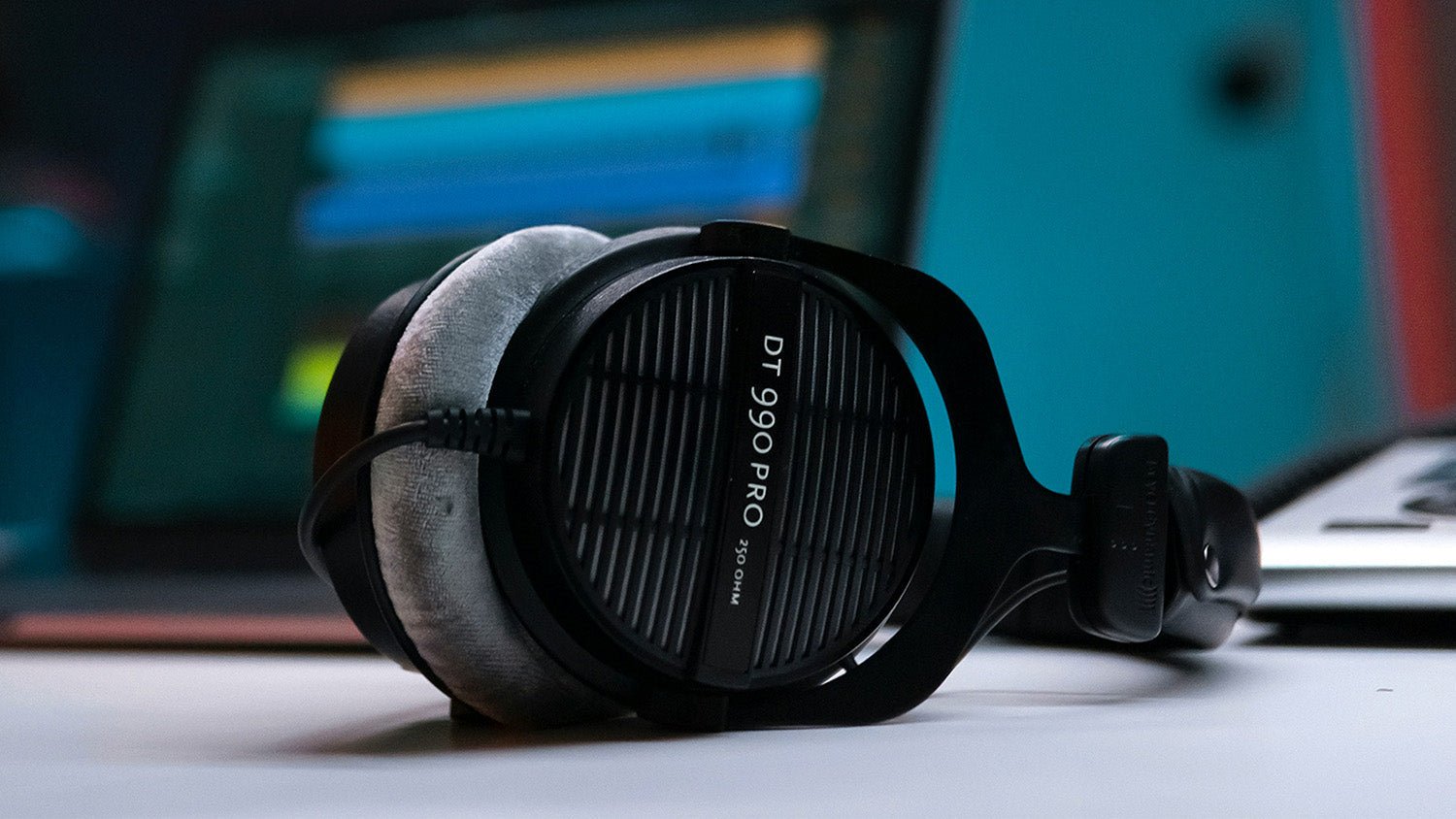
Hear More than the Speakers Allow
Headphones That Hear More There are headphones that play, and there are headphones that hear. The former are for entertainment, the latter for truth. Between these two worlds stand creators, musicians, and audiophiles, seeking not loudness, but accuracy. They know: when sound becomes clean, everything unnecessary disappears – only the music remains. Studio Headphones – Not an Accessory, but a Work Tool Studio headphones were not born to play pleasantly. They were created to conceal nothing. Accurate, sometimes even "brutally" open, they reveal everything: from an overly bright vocal to a barely perceptible mistake in a drum track. They don't caress the ears – they teach you to listen. When working with sound, such precision is essential. Speakers can lie due to room acoustics, but headphones never do. Therefore, producers, engineers, and even YouTube content creators rely on headphones as a microscope, allowing them to see sound details that the naked ear doesn't notice. Open and Closed: Two Listening Philosophies In the world of sound, construction determines the experience. Closed-back headphones are a recording tool. They prevent sound leakage into the microphone, making them essential for vocalists and instrumentalists. Such headphones create an intimate, concentrated sound – as if you were sitting among your own thoughts. Open-back headphones, conversely, allow sound to breathe. They open up a wider soundstage, providing a sense of space and realism. This is the primary choice for mixing or listening to high-resolution recordings – when it's not just the sound that matters, but its depth. Listening through open-back headphones, you hear not just the song, but also the air between the notes. That emptiness that makes music alive. When Not Decibels, but Voltage Matters The technical side is simple: headphones cannot sound better than their power allows. Many studio headphones have higher impedance – 80, 150, or even 250 ohms. This means they need a stronger source than a phone or laptop. This is where the audio interface or DAC comes in – a small but crucial component that converts the digital signal into a live, analog sound. A properly chosen interface can fundamentally change the quality of listening. Suddenly, the bass becomes defined, the vocals clearer, and everything that once seemed "compressed" gains space. This is not magic – it's physics, where every milliampere matters. Headphones That Let You See Sound Sound is visual. It can be felt like shadows of light, contrasts of color. When a creator works with headphones, he essentially paints the sound – shaping its lines, textures, brightness. Therefore, headphones must not only be accurately reproducing devices but also reliable partners. They must convey everything as it truly is – without "bass boost," without cosmetics. It is this relationship between man and equipment that allows for the creation of music that sounds not only good but also right. Because sometimes, when everything stops, when the sound is clean and quiet, you can hear yourself. When Work Becomes a Ritual In creativity, headphones become a personal space. It's a place where noise disappears – both external and internal. Anyone who has ever worked at night, when everyone is asleep, knows that feeling: the light from the monitor, the quiet hum of the DAC, and the sound that comes alive between the ears. It's like a small world where only you and the music remain. Therefore, studio headphones have today crossed the boundaries of professionals. Amateurs who want to experience true, authentic sound also use them. They no longer measure "goodness" in decibels – they measure emotion. Technology Worth Noting Classic names remain the same: Audio-Technica, Beyerdynamic, Sennheiser, Focal, Audeze, Shure – each manufacturer has its own character. Beyerdynamic is known for surgical precision, Focal for naturalness, Audeze for its massive planar magnetic sound. But all of them serve one purpose – to help a person hear more than just sound. Finally: The Value of True Silence Good sound always begins with silence. Not with equipment, not with budget – but with silence, in which listening emerges. When headphones can draw you into this silence, they become more than just technology. Then music turns into memory, and every sound – a moment you don't want to miss. Where to Buy You can find headphones and other studio equipment in our e-shop stageiq.lt or in the store at Baltupio g. 71A, Vilnius.


